How a thermal water is born
It all begins with the rain.
Water seeps into the earth and sinks to depths of between 2,000 and 3,000 metres, where geothermal heat warms it to 90–130 °C. On that journey it dissolves the minerals of the rocks it passes through and, by the thermosiphon effect — hot water weighs less and rises — it climbs back up through the tectonic fractures to the surface.
The discharge rate of these geothermal systems is remarkably constant, because their reserves are so abundant. That is why our spring never stops: the water flows continuously through the balneari, never recirculated or reused, keeping its biological, physical and chemical properties intact. Every bath is taken in water that has just arrived from the earth.
What it carries: composition and properties
The water of Caldes d'Estrac has been declared of public utility for its healing and therapeutic properties. Its mineralisation comes from the granitic minerals of the Littoral range, incorporated by sedimentation on the way up. Chemically it is a nitrogenous, ionised water containing radon gas — delicate properties, difficult to preserve when a thermal water has to be artificially heated or cooled.
And here lies our great singularity: we never have to manipulate it. Other thermal waters emerge at 70, 50 or 20 degrees and must be adjusted for human use. Ours emerges at 38.8 °C, the ideal temperature for the body. From the earth to the skin, with no steps in between.
These properties make it indicated for joint and rheumatic problems, skin conditions, the respiratory system and stress. We detail it all in our thermal water therapies.
A unique spring between the mountain ranges and the sea
Catalonia's hydrothermal manifestations appear in two great units: the Pyrenees and the Catalanides — the Prelittoral and Littoral ranges, separated by the Prelittoral depression. Their recharge zone is the Montseny massif, and the waters circulate at depth through the faults.
The spring that rises in Caldes d'Estrac sits at the point of tectonic fracture where a fault brings the Vallès-Penedès depression into contact with the Littoral system, near the Caldetes watercourse, at a depth of some 2,800 metres. Its thermal trunk is branched by surface fracturing: from the same geological family spring the Font Picant in Argentona and the Titus spring in Arenys de Mar. But it is here, in Caldetes, that the water emerges thermal, constant and at just the right temperature — and where a whole village grew up around it.
A village that has lived off hot water for centuries
Caldes d'Estrac — Caldetes — carries the water in its name: caldes, hot waters. Around the spring flourished one of the oldest thermal traditions on the Catalan coast, and with it a summering town that drew artists and illustrious visitors. Today that legacy lives on a few steps from the balneari: the Fundació Palau holds one of the most important private Picasso collections in Spain, with works by Tàpies, Miró, Barceló and Perejaume. A museum morning, a thermal-water afternoon: the same combination that charmed the summer visitors of a century ago, 50 metres from the beach.
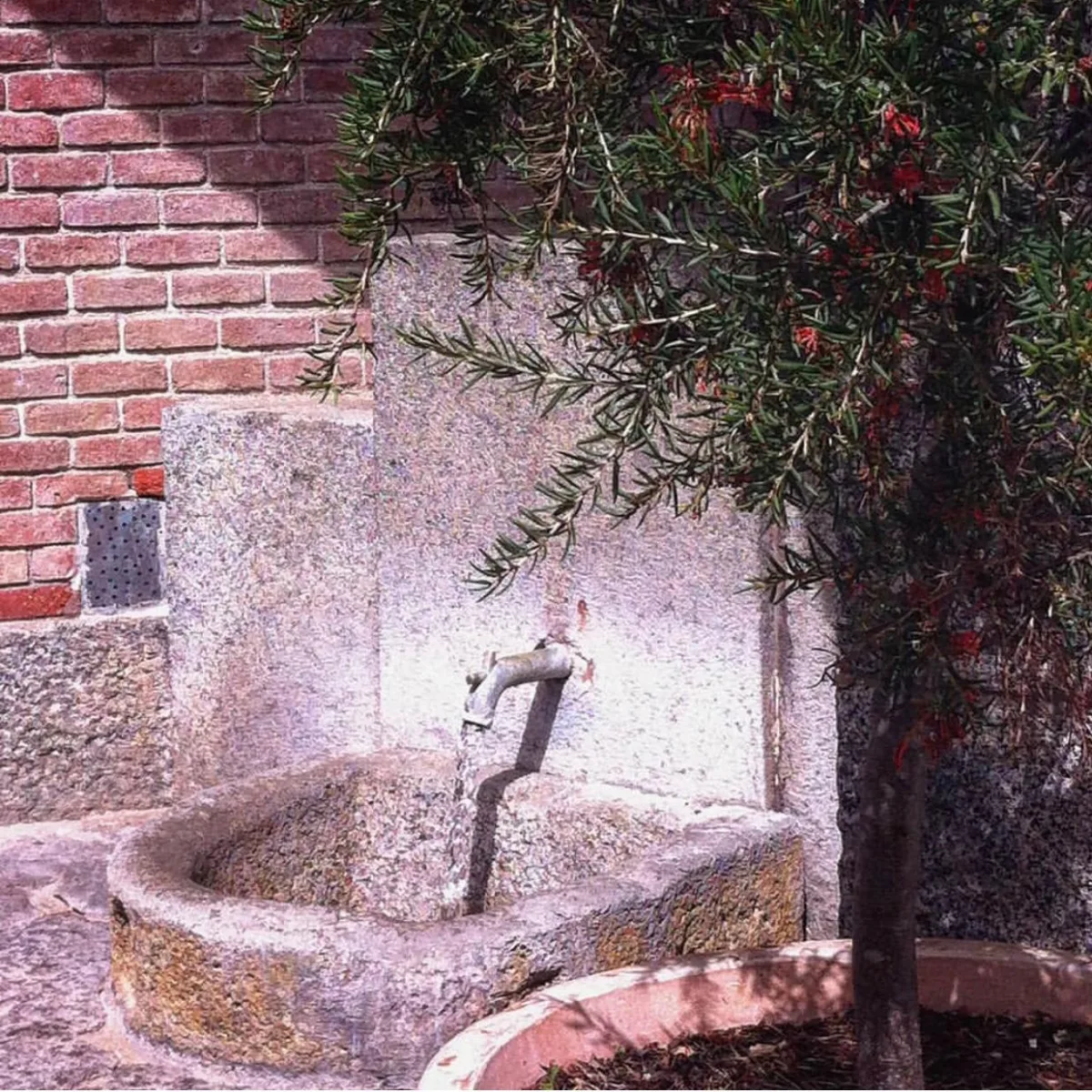
The same water, a renewed fountain
We have renewed the fountain of the spring so the water is presented as it deserves. What does not change is the essential: the same flow and the same temperature that the analyses have recorded for over 200 years.
This water is not to be explained: it is to be felt.
Discover the thermal water therapies that turn it into health, and book your visit.